
All created things, even the lowliest, are partially similar and partially dissimilar to God.
Girolamo Zanchi
Five Books on the Nature of God,
or
On the Divine Attributes
or
On the Divine Attributes
By Girolamo Zanchi
Translated by Patrick J. O'Banion
Book 1, Chapter 8, Quaestio 6, Part 1
Volume 1 is available for order now from Merchant Royal Press
Quaestio 6
Is it appropriate for God to be called even by names derived from the lowliest creatures?
The Thesis
God can (and appropriately so) be named by whatever names He chooses to name Himself, even those derived from the lowliest of creatures.
Indeed, God can do whatever He wills, and whatever He does is good, righteous, and honorable. But does anyone doubt that He wanted Himself to be named even by the lowliest of created things, since that is how He is addressed in the Holy Scriptures? For a pious person, this reason alone should suffice. And yet, hearing another reason—one drawn from the resemblance that all creatures, even the lowliest, have with God—might also be useful.
This is a useful reason, one that is necessary for understanding on account of the great learning encompassed by it. All created things, even the lowliest, are partially similar and partially dissimilar to God. They are similar insofar as they have been granted and adorned by God with some divine perfection. For one thing is said to be like another because it possesses some of the other’s essential form or quality. An example of an essential form is when a man’s son partakes of human nature, and in this the son is similar to his father in essential form. And this similarity is most perfect. A quality, however, might be either of the soul or of the body, such as when one person’s features and bodily form or the virtues of his soul are similar to another’s.
Now, God made every created thing to be a partaker of some divine perfection, some to a greater and more excellent extent and others to a lesser and not so surpassing extent. For, some partake only of being; others partake of feeling and reason in addition to being. And thus, some have more similarity to God than others.
From this, an appropriate conclusion is that Christ is of the same divine nature and essence as the Father, for an utterly perfect similitude consists in the participation of the other’s essential form, as we already showed with the example of a son begotten by a man. Christ, however, is so similar to the Father that nothing could possibly be more similar. This is why Christ is called God’s image (meaning: His essential and absolutely perfect image) and the engraved form of His person [Col. 1:15; Heb. 1:3].[1]
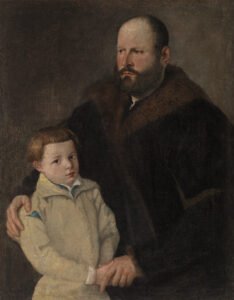
Hence, it is also the case that it cannot rightly be said that God is similar to any creature.[2] For the one who gives his quality or form to another is not said to be similar to the one to whom the quality or form is given, just as Peter cannot be said to be similar to his own image. Conversely, rather, the one who receives the form or quality of another is said to be like the other, as an image of Peter is similar to Peter, or as a son is similar to his father but not the father to the son.
[1] χαρακτὴρ ὑποστάσεως αὐτοῦ. I have translated this phrase in accordance with the rendering of the Geneva Bible (1599). Modern translations tend to read ὑποστάσεως as referring to the divine nature, however, early modern exegesis understood this as a reference to the person (ὑπόστασις) of the Father. The latter is Zanchi’s understanding of the usage in Heb. 1:3. See above p. 83 (bk. 1, ch. 4, §7).
[2] Zanchi follows Pseudo-Dionysius’s The Divine Names (ch. 9, §6) in this section. See The Complete Works, 116.