
The affirmative names of God do not deny something in God ... but instead affirm things and virtues in Him. Yet, they do so by way of essential union rather than by way of composition. For, in God, all these things are the divine essence itself.
Girolamo Zanchi
Five Books on the Nature of God,
or
On the Divine Attributes
or
On the Divine Attributes
By Girolamo Zanchi
Translated by Patrick J. O'Banion
Book 1, Chapter 7, Quaestio 2, Part 2
Volume 1 is available for order now from Merchant Royal Press
Notwithstanding, as soon as I have refuted two errors about them, I will explain in what sense [these] names are said to be predicated of God essentially.[1]
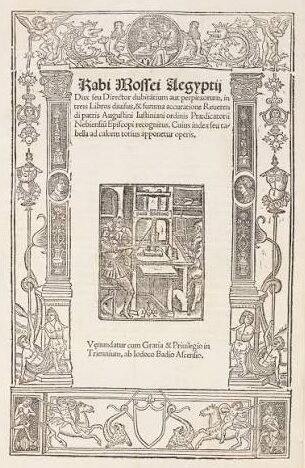
Some have indeed denied that the names spoken of God affirmatively and absolutely are spoken essentially.[2] Some have thought that, while these names are spoken of God affirmatively, nevertheless, they are actually removing something from God and negating rather than establishing and affirming something in God. For instance, when we say that God is living and intelligent, they want these names to signify that God does not exist in the same way [as other things], that He is not of the same kind as are inanimate things, and that He is unlike things that lack reason or intelligence. Rather, He is something more excellent. Yet, nothing is established or affirmed in God by these names. This was the opinion of Rabbi Moses Egyptus ([Guide to the Perplexed,] bk. 1, ch. 58).[3]
Others, however, supposed that these names signified nothing more than a relationship (σχέσιν) between God and things created by Him, such that these names denote nothing in God other than that He is the cause of the sort of things that are signified by the names. For example: God is good, righteous, and wise. For they suppose that this speech act merely signifies that God is the cause of the goodness, righteousness, and wisdom found in [created] things.[4]
But both of these opinions are erroneous, which I will easily demonstrate in three ways. First, on the basis of the Scriptures, it clearly appears that God meant to indicate that He actually is of such a kind as the names themselves signify, albeit much more perfectly than the way in which these qualities are found in created things. This is taught by the purpose on account of which God names Himself to be of such a kind—whether merciful or powerful. His purpose is that we might, as a result, have confidence when we approach and call upon Him.
But how are we made confident as a result, if the names merely signify that God is but the cause of mercy and power in other things rather than that He Himself is merciful or powerful? This is confirmed by the fact that, in Mathew [that is, Luke 6:36], Christ based His encouragement to pursue these virtues upon the example of the Father: Be merciful, therefore, just as your Father also is merciful. If He is called merciful for no other reason than because He is the cause of mercy in us, then Christ is not encouraging us to be merciful in ourselves but rather to be mercy in others, whether as originators or (minimally) as assistants. The command of God Be holy just as I also am holy [Lev. 11:44; 1 Peter 1:16] also pertains to this. Certainly, He does not command us to be the originator of holiness in others but rather to be imitators of Him in ourselves.
So then, when Scripture says that He chose us or He loved us, should we not understand that a decree in God preserves us? Or that He loves us? Or should we merely understand that He is the originator of the love in us and of the election whereby we ourselves chose God? Could anything be more foolish or wicked?
From this follows the second reason why this opinion is erroneous, which is that it leads to absurdity. For if God is said to be righteous, merciful, and good, and if He is called by other names only because He is the cause of righteousness (and other virtues) in other things but not because He is Himself actually righteous, then it follows that the name righteous and the other virtues are more properly and primarily predicated of creatures than of God. For what, by way of example, is primarily and more properly called healthy, an animal or medicine? Obviously, an animal, for it is formally and actually healthy but the medicine is only called healthy because it is the cause of health in something else.
But this is utterly absurd, for good, righteous, and so on are primarily and more properly predicated of God than of us. The reason is because, just as we and other rational creatures are not being except as we participate in being, so we are not righteous or wise except by participation in righteousness and wisdom. Accordingly, if one is Being per se then, in the same way, he must also be truly righteous and good per se. Who would that be, if not God? Otherwise, an analogy would exist from God to creatures but not from creatures to God, which is the most absurd thing of all.
Finally, another absurdity follows: God can just as rightly and truly be called a body, iron, an ant, a tyrant, and other rather vulgar or injurious names as He can be called Spirit, Father, Lord, righteous, and merciful. For He is also the cause of all bodies, and He makes tyrants, and He even creates wicked men for the evil day, as Scripture teaches [Prov. 16:4].
But on the contrary, Scripture denies that God is a body; it denies that He is a tyrant; it denies that He is wicked. In what sense, I pray, does Scripture deny that God is a body or a tyrant or wicked? Certainly, not because He is not the cause of bodies or the maker of tyrants but because He really and formally (as they say in the schools) is neither a body nor a tyrant.
Therefore, when Scripture calls Him righteous, good, and wise, He really is such. And the reason why Scripture calls Him these things is because He really is. Thus, the affirmative names of God do not deny something in God (as Rabbi Moses [Maimonides] said) but instead affirm things and virtues in Him. Yet, they do so by way of essential union rather than by way of composition. For, in God, all these things are the divine essence itself.
[1] οὑσιωδῶς.
[2] οὑσιωδῶς.
[3] Maimonides writes: “Of this Being we say, ‘He is,’ meaning, that He cannot fail to exist. We find this Being to be unlike the elements, which are lifeless bodies. So we say, ‘He is alive,’ meaning not lifeless. We find further that He is unlike the heavens, which are living bodies. So we say, ‘He is not a body.’ We learn further that He is not like the mind, which is deathless and incorporeal but has a cause. So we say, ‘He is eternal,’ meaning that He owes His being to no cause. We then recognize that this Being, whose essence is His existence, suffices not only to itself but also to give being to many things more, not as heat flows from a flame or light from the sun, of necessity, but in a flow ever sustaining and wisely ordering and governing the rest, as I will show.” The Guide to the Perplexed, 104.
[4] Zanchi probably had John of Damascus’s position in view. See On the Orthodox Faith, 82–83 (bk. 1, §9).