
To be sure, God’s many names are used neither to signify that various different things are in Him (since He is most simple) nor to perceive what He is according to His essence (since He cannot be perceived). All of this is most true.
Girolamo Zanchi
Five Books on the Nature of God,
or
On the Divine Attributes
or
On the Divine Attributes
By Girolamo Zanchi
Translated by Patrick J. O'Banion
Book 1, Chapter 5
Volume 1 is available for order now from Merchant Royal Press
Chapter Five
The general use of all the divine names.
In the ninth chapter of the first book [of On the Orthodox Faith], the Damascene, who certainly was a learned man, does two things in order to explain the use and purpose for which God’s names were disclosed. He says, first, that none of the divine names were disclosed in order to signify thereby what God is essentially.[1] Nor should we imagine that the various names of God indicate distinct substantial differences in God [diuersas substantiales Dei differentias], for God is most simple. I understand this to mean that what God is essentially[2] cannot be understood or explained by any one or by all of His names.
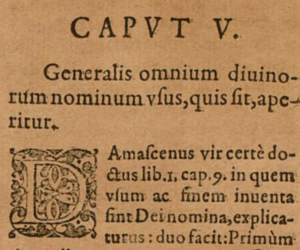
This is why we should not imagine that all these many names were disclosed so that we could thereby understand or explain what God is. To be sure, God’s many names are used neither to signify that various different things are in Him (since He is most simple) nor to perceive what He is according to His essence (since He cannot be perceived). All of this is most true.
The second thing that the Damascene does is explain the uses of God’s names. He says, first, that negative names such as immortal and invisible[3] are used to signify what He is not.[4] He says a second use of God’s names is to signify some relation with those things that are distinguished from God.[5] For example: Creator, Lord, King, and Savior. Third, he says that the names signify those things that indicate to us what follows from God’s nature[6]—what we call His attributes, such as the names just, good, powerful, and so forth. He says that a fourth use is to denote God’s activity,[7] that is, the divine operations.[8]
Although I do not completely disagree with what the Damascene wrote, he does not say everything. Therefore, in order to comprehend the uses of the divine names better and more clearly, I judge that the following [uses] are also easily gathered on the basis of what has been said.
First, God gives and reveals some names to signify what He is not. Hereto pertain all the negative names, such as immortal, invisible, and without beginning.[9] And on this point, I agree with the Damascene who understands this rightly and explains it as it is.
Second, some names are written, not to comprehend the essence—for who can comprehend the incomprehensible One?[10]—but to denote or indicate the essence concerning which the rest of the names are predicated. Such are the names Jehovah, Yah,[11] and others of that sort. On this point, I disagree with the Damascene. The learned readers of these things will judge whether I do so rightly or wrongly.
Third, some of the names actually indicate the plurality of persons and distinctions between them, such as the name Elohim or hypostasis[12] and the names Father, Son, and Holy Spirit. And in this way, we may understand who this God is. The Damascene actually omits this use, but imprudently.
Fourth, other names are given in order (as the Damascene says) to signify what follows from God’s nature,[13] that is, to signify God’s attributes or essential properties. This was very well said and observed.
Fifth, some of the names are given in order to clearly show the relationship (σχέσιν) that God has toward creatures. Such are the names Creator, King, Shepherd, Lord, Redeemer, and Judge. And thus, the works of God, both those that He is doing and those that He has done, are simultaneously indicated.
Sixth, abstract names signify that God is a most simple and perfect essence and, at the same time, that He is also the cause of all perfection in [other] things. Concrete names, however, signify that He is a thing [rem] truly subsisting.
In summary, the use of all the names is to indicate either who God is or what He is like. However, what He is like is shown either from His attributes or His works. Accordingly, the sort of names that have been provided are those whereby God’s attributes and actions are signified. Responding to individual questions will now be easy.
[1] κατ᾽ οὑσίαν. See John of Damascus, On the Orthodox Faith, 83–84.
[2] κατ᾽ οὐσίαν.
[3] ἄόρατος, ἄφθαρτος.
[4] τὶ οὐκ ἐστὶ.
[5] σχέσιν τινὰ πρὸς τὶ τῶν ἀντιδιαστελλομένων.
[6] τὶ τῶν παρεπομένων τῇ φύσει.
[7] ἐνέργείαν.
[8] This paragraph dissects a single sentence in John of Damascus (bk. 1, ch. 9). Unusually, Zanchi provides both the Greek and his own Latin translation of the Greek, which have been combined here in order to avoid redundancy. The translation in the text here is based on the Latin, but in consultation with FOTC, 37:189 and John of Damascus, On the Orthodox Faith, 83.
[9] ἄφθαρτος, ἄόρατος, ἄναρχος.
[10] ἀκατάληπτον.
[11] יה.
[12] As Zanchi noted above, and as he argues at length in De tribus Elohim, he understands the Hebrew plural noun Elohim to be a reference to the three divine hypostases.
[13] τὶ τῶν παρεπομένων τῇ φύσει.