
A
 ccording to the Greek etymologists, κύριος is from κύρεος. And κύρος means ἐξουσίαν (that is, authority). Hence, κύριος is a word said of (and a κύριος is) one who has right and authority (or ἐξουσίαν) and dominion over a certain thing, and to whom some possession belongs whereof he is called κύριος. Indeed, this name is one of those which are in relation to something.[1] Thus, the Latin word Dominus means the same thing: the one who has right over a certain thing as his possession. Lawyers define dominion as that right whereby we make a thing our own and proper to us. Dominus is said with reference to the word domus [house], for one is properly called a dominus who is in charge of a domus and who has unrestricted legal right [liberum ius] and absolute power [imperium] in it and who, therefore, rules the family and whom the family serves and obeys (or, whom the family is bound by law to obey and serve).
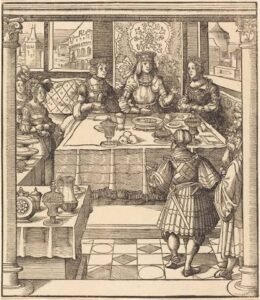
 Now, legal right and absolute power [ius atque imperium] of that kind is called dominion, and from there the word was subsequently applied to every type of right and dominion because there was once no greater or wider dominion than that which was delimited by the boundaries of our houses and dwellings. Hence, feasts celebrated at home were called dominia [banquets], because they were celebrated by the domino domus [the lord of the house]. And he who celebrated the feast and in whose presence the feast was eaten was customarily called the dominus.
From this it came to pass that whoever has a right to something is called its dominus, even if he does not possess it. For dominion differs from possession, and a dominus is often distinct from a possessor. Accordingly, he who has legal right and absolute power over a certain city and people—whether in a province or some kingdom—is properly called and is its dominus. But if someone simply has full and unrestricted right over everything and over all other lords, then he should most properly and simply be called dominus or dominus dominantium [lord or lord of lords].
God alone is worthy of so excellent a title. Indeed, He has absolute, unrestricted, and eternal right over everything contained within the compass of heaven and earth. Thus, the seventy interpreters correctly always translate the name Jehovah, God’s proper name, as κύριον, that is, Lord. For only Jehovah God is in charge of and rules over this great house, which consists of heaven and earth and that which is in them, and He alone has full κῦρος (that is, ἐξουσίαν) and right and authority. For this reason, the only one who is worthy [of this name is] He who is simply and absolutely called the Lord, just as He in fact is called in the Holy Scriptures.
I. Now we have the etymology and significance of the name κυρίου and Domini, and we know who is properly called Lord. And thus, we conclude that this name is most properly suitable for God alone.
On a thousand instances, however, this name is absolutely and simply predicated of Christ in the apostolic writings. Accordingly, we gather from this (that is, on the basis of this name) that Christ is true God, not only because He, along with the Father and the Holy Spirit, is the Author and Governor of this whole house as Hebrews 2:3 teaches, but also and especially because He is the Gatherer, Founder, Builder, Savior, and Defender of the church, which is called the house of God, as the Scriptures teach throughout. From this, He is repeatedly called the Head of the household, namely, of the whole family of this world (meaning, of created things, particularly men and angels) but chiefly of the whole church. The Head of household truly is the Lord of house and family.
 II. But it should be noted that although the name God and the name Lord is predicated of the Son as it is predicated of the Father, nevertheless, the customary practice of the Holy Spirit in the apostolic writings is that, when He speaks about the Father and the Son, He names the Father God and the Son Lord. Anyone who has read the New Testament a single time notices this. And, as Tertullian very ingeniously observed, the Son is nevertheless separately called God and the Father is separately addressed as Lord (Against Praxeas, ch. 13).[2]
The reason for this is twofold. First, because the Father is the fountain of the whole deity in the Son, the name God is principally and par excellence attributed to the Father. The name Lord, however, is principally and par excellence attributed to Christ, since He was constituted Lord of all by the Father and, according to John 17:2, the Father gave Him power over all flesh. Second, because, in the mystery of redemption, the Father, as the first cause and the fountain of salvation, remained in His glory and majesty. But He sent the Son.
Hence, Christ: God (the Father) so loved the world that He gave His only begotten Son (John 3:16). This is also why the name God is first given to Him. But the Son, chosen and marked out to perform the office of redeemer while He was in the form of God, was unwilling to remain in that form with a majesty equal to the Father. Rather, He emptied Himself, taking on the form of a servant. And so, while setting aside His glory, He also set aside the name God and, along with taking on the form of a servant and servitude, also took up the name servant, namely, with respect to the Father, to whom He became obedient, even unto death. Hence also, according to Isaiah 42:1, the Father calls Him servant, which is also cited with reference to Christ in Matthew 12:18.
With respect to us, however, just as He was in a special way constituted our Lord and we were given to Him as His inheritance and so that we might serve Him and know, cherish, and adore Him as our Head and Savior, so also was the name Lord given to Him in a special way by the Father. For the Father constituted Christ the Heir of all things, and He subjected everything to Him and commanded even the angels to adore Him, as is explained admirably in the epistle to the Hebrews.
Hence, even if Christ actually always remained God and remained in the form of God in which He was, nevertheless, because the Father constituted Him the Savior of the whole world, He emptied Himself, having been made man, such that He obeyed the Father all the way to death. On that account, He put aside the name God unto His death and took on two other names: Servant and Lord. In fact, [He took on] the name Servant with respect to the Father, to whom He became obedient unto death, and for that reason He always, as Servant, called upon the Father as His Lord. He entreated help from Him and rendered everything unto Him, as unto His Lord. But He was assigned the name Lord with respect to us, whose Head, Savior, Redeemer, and King He is constituted.