Five Books on the Nature of God,
or
On the Divine Attributes


By Girolamo Zanchi

Translated by Patrick J. O'Banion

Book 1, Chapter 13, Part 1

Volume 1 is available for order now
from Merchant Royal Press

It seems that God desired to have the idea of His name among all people and, thus, to show to the whole world that He is God not only of the Jews but of all people, even the gentiles.

Chapter Thirteen

The name יהוה [Jehovah].

As regards the name יהוה, I must first address the various ways of writing this name and how it is that, for almost all peoples, God’s name consists of four letters. Second, I must address its pronunciation and reading and why it is described as ineffable among the Hebrews such that even the Greeks call it the unpronounceable[1] name. Third, its etymology and meaning and, hence, what the name Jehovah properly signifies. Fourth, whether it is God’s proper name and, thus, appropriate for God alone. Fifth, I must demonstrate that in the Scriptures, taken in a simple sense and properly speaking, the name יהוה is not only attributed to nor only appropriate for the Father but also for the Son and the Holy Spirit. And so, the Son and the Holy Spirit no less than the Father are the true Jehovah. Sixth, something will be said about the establishment of this name: whether it was contrived by men or, in fact, was imposed by God upon Himself, and at what point God first called Himself Jehovah and revealed this name to the patriarchs. Seventh, the mysteries that the Hebrews infer from this name. Finally, I will address the true use of this name in contrast to the abuse of superstitious men and for the comfort and benefit of the faithful.

The Various Ways of Writing the Name יהוה

First, in the Holy Bible it is the case that יהוה is always written in full with those four letters, and this is why everyone—not only the Latins but also the Greeks—calls it by way of excellence[2] the tetragrammaton, the four-letter word.[3] Indeed, from what the Hebrews have consistently said, this name of God is ineffable, whence it happens that, just as they have said (and still do say) Adonai in place of יהוה, so the Latins and Greeks are accustomed to indicating God’s most holy name (that is, the name יהוה) with the tetragrammaton.

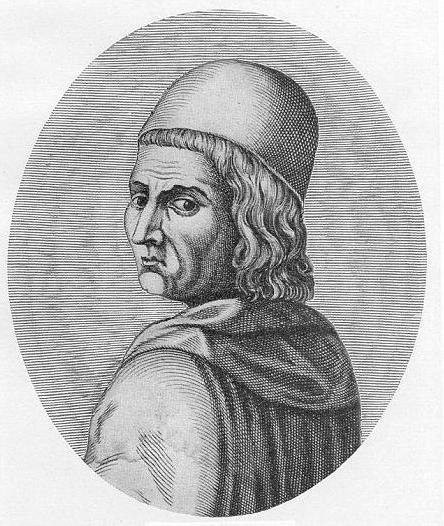
Marsilio Ficino
Now, I do not know whether this or something else is the source [of the fact] that, among almost all peoples and tongues, God’s name consists of and is written in four letters.[4] For just as the name יהוה consists of four letters among the Hebrews, which they call God’s proper and essential name, so too, following the Hebrews, does the name God consists of four letters among the Greeks, namely, θεòς. Thus, among the Latins Deus, whence the Spanish says Dios, the Italians Idio, the French Dieu, the Germans and the English also use four letters Gott.[5] Thus, the Chaldeans: אלהא and the Syrians likewise: אלהא; the Arabs: אללא, differing only slightly from Chaldean and Syriac; the Ethiopians: אמלב; the Egyptians: θωύθ, differing only slight from the Greek θεòς. For the Assyrians, it is אדאד; for the Persians Σύρη, whence probably the French Sire for lord, which is Signore for us [Italians]. For the Magi: Orsi; for the Dalmatians and Illyrians: Bogi; for the Muslims [that is, the Turks]: Abgd. Finally, if what is written is true, for the people discovered in the New World (as they call it) there is likewise a name of four letters: Zimi.[6]

I do not know how it is that God’s name among all peoples is a tetragrammaton[7] (that is, a four-letter word). Did it originate from the fact that everyone understood that among the Hebrews (whose religion was always well known and among whom the true God was said to dwell) that the name of God consisted of four letters? Or did this come about from some other source? The first notion seems plausible, but I still do not dare assert it dogmatically. To be sure, it did not happen apart from the singular providence of Jehovah God.

Indeed, this is a great thing and worthy of admiration. And all the more because it seems that God desired to have the idea of His name among all people and, thus, to show to the whole world that He is God not only of the Jews but of all people, even the gentiles (as the apostle says in Romans). And it seems that He desired to have elect ones, whose Father and Savior is Jehovah, in all four corners of the world. In the same way, Christ also said that He would gather His elect by means of angels from the four winds, that is, from the four corners of the world [Matt. 24:31]. And this pertains to what is written in Revelation 4 and other passages concerning the four living creatures, that is, concerning the ministers of the Word raised up by God in the four corners of the earth, in order that all the elect might be drawn to Jehovah through them by the preaching of the gospel. This is what I can say about why God desired His four-letter name to be present not only among the Hebrews but also among all the other peoples. Thus, we have the first way of writing the name Jehovah.

Second, the ancient Hebrews removed the final ה and put a ד in its place and read it as: יהוד [Yehud]. Some say that the reason why the Jews wrote it like that was to indicate that this יהוה would take on flesh from Judah in such a way that, from יהוה and Judah, there would be one Immanuel, who is Christ Jesus, of the tribe of Judah, God and man. This is what some say.

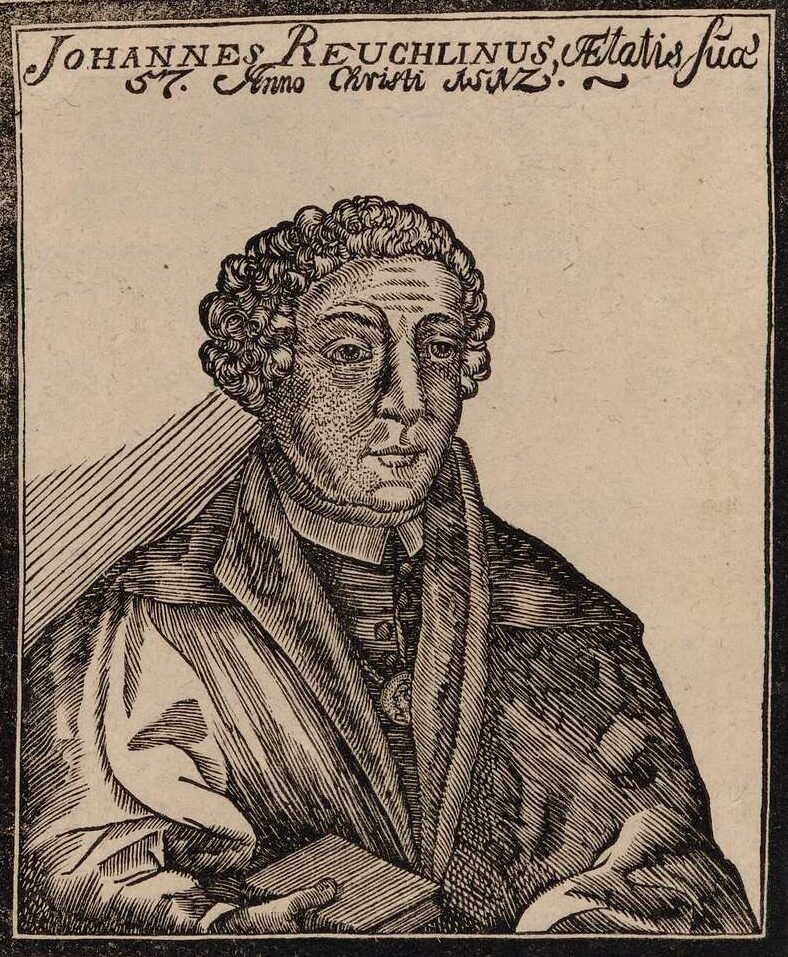
The third form was that which the Chaldeans used. For in place of the four letters, they solemnly wrote points in a specific arrangement, in one of these two ways. Reuchlin alleges that the reason for this was to preserve the four-letter name, written by God’s own hand, from being debased.

Fourth is another form employed by the Chaldeans and which the rabbis then made use of (and still do) in their commentaries. They would write three yods[8] of equal size, one hanging above two others beneath it, with one chametz subscripted beneath all of them. And then they enclosed all three yods, as though in a circle.
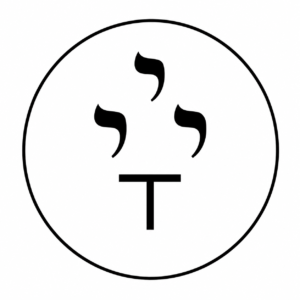
Galatino alleges the reason for this, writing that the ancient Chaldeans wished to indicate that the one Jehovah consists in three equal persons (essential parts, as it were) inseparable from one another, each of whom subsist as one and the same essence and deity. I am merely recounting what he writes, not that I would want our faith to depend on these Kabbalisms.
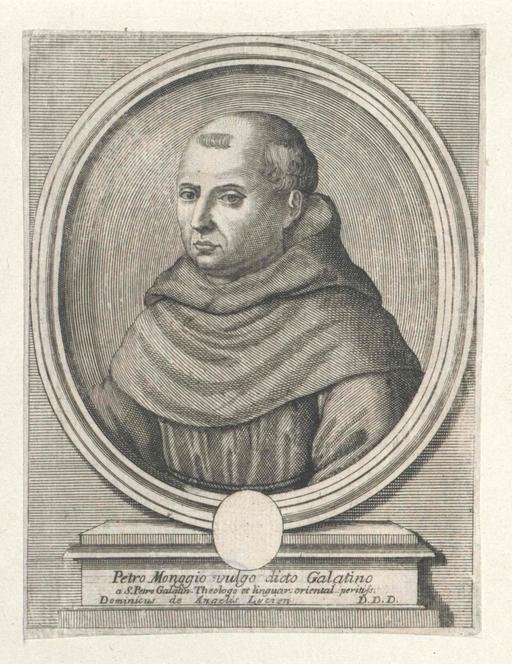

Pietro Galatino
Fifth, it is also sometimes customary for this name to be written with three points in the place of the three yods, with a straight-line underneath in place of the chametz.[9] And they said that this figure was also meant to signify the Trinity of persons in one essence.But why would they be in the habit of representing the name Jehovah in so many different forms with the letters of the name itself omitted? The real reason was superstition, since they imagined that the name Jehovah could be debased and, as it were, profaned if even those letters, which God Himself had given in writing to Moses, were depicted. This is also the reason why they did not dare to pronounce the name but instead called it ineffable. This, I believe, is the real reason; the others are fabricated.

[1] ἀνεκφώνητον.

[2] κατ ἐξοχὴν.

[3] τετραγράμματον pro τετράρων γραμμάτων.

[4] Marsilio Ficino had raised the question “Why does everybody call God by four letters?” in his commentary on the Philebus. See Marsilio Ficino, The Philebus Commentary: A Critical Edition and Translation, trans. Michael J. B. Allen (University of California Press, 1975), 142–44.

While Ficino noted several of the cross-cultural linguistic examples subsequently listed by Zanchi, others are likely drawn from the Dictionary of Ambrogio Calepino (c. 1440–1510), which was first published in 1502 and then reprinted more than 200 times into the late eighteenth century. Later editions added research in additional languages to Calepino’s original work, which included only Latin and Greek. Calepino, by coincidence, was born and died in Bergamo, where Zanchi spent much of his youth.

[5] In Life Everlasting, Robert Hill observes on this point: “The english, though written with a single d for brevitie sake, yet comming from the German word, as very many english wordes doe, the english I say is Godd” (22).

[6] Yi Wang notes that Fray Ramón Pané, who accompanied Columbus on his second voyage to the Americas, provided the detail that the Taíno people used the word “Cemí” for gods and spirits in his Relación acerca de las antigüedades de los Indios (1498). “Girolamo Zanchi and Divine Names” (2026), 182.

[7] τετραγράμματον.

[8] י.

[9] Wang suggests that Zanchi refers here to the “classical Syriac ligature of ‘Yah’ (ܞ).” “Girolamo Zanchi and Divine Names” (2026), 143.

Share :