
Five Books on the Nature of God,
or
On the Divine Attributes
or
On the Divine Attributes
By Girolamo Zanchi
Translated by Patrick J. O'Banion
Book 1, Chapter 12, Part 1
Volume 1 is available for order now
from Merchant Royal Press
Although He is indeed one Jehovah, He is neverthless multiple Elohim (that is, "persons" or "hypostases").
Girolamo Zanchi
Chapter Twelve
The name אלוהים [Elohim].
The singular of this name is אלה, which is found rarely in the Holy Scriptures but very often in the plural אלוחים. The root is אלה, and the general opinion is that this name signifies strength and power. And God is called אלוהים [Elohim] on account of the fact that He is omnipotent. This is why Moses, in telling of the creation of all things, which demonstrates supreme power, called the creator of everything Elohim,[1] saying Elohim created[2] (Gen. 1:1). Thus, Scripture calls those whom God establishes in higher positions elohim[3]—kings, magistrates, judges, and even angels, whom He has put in charge of human affairs and to whom He has assigned great strength to perform great deeds.
Hence, this is a name of power, force, and of great strength and, so, is most excellently suited to God. Indeed, properly speaking, it is suitable for Him alone and is suitable for angels and men improperly,[4] namely, on account of the power and authority communicated [to them] and their duty to rule the world, kingdoms, and cities and to provide aid to others and to defend, sustain, and nourish them. Accordingly, Jehovah God alone is the true Elohim.[5]
Now, we must observe how this name is predicated of Jehovah God in the Scriptures, for sometimes it signifies multiple persons (namely, either two or three) and sometimes it indicates only one person, which happens when a specific person is designated by a particular personal property or relation. Examples of the first are infinite, such as in Genesis 1[:1]: In the beginning Elohim created. Again: And Elohim said, “Let Us make man after Our image” [Gen. 1:26].
[1] אלוהים.
[2] ברא אלוהים.
[3] אלוהים.
[4] καταχρηστικῶς.
[5] אלוהים.
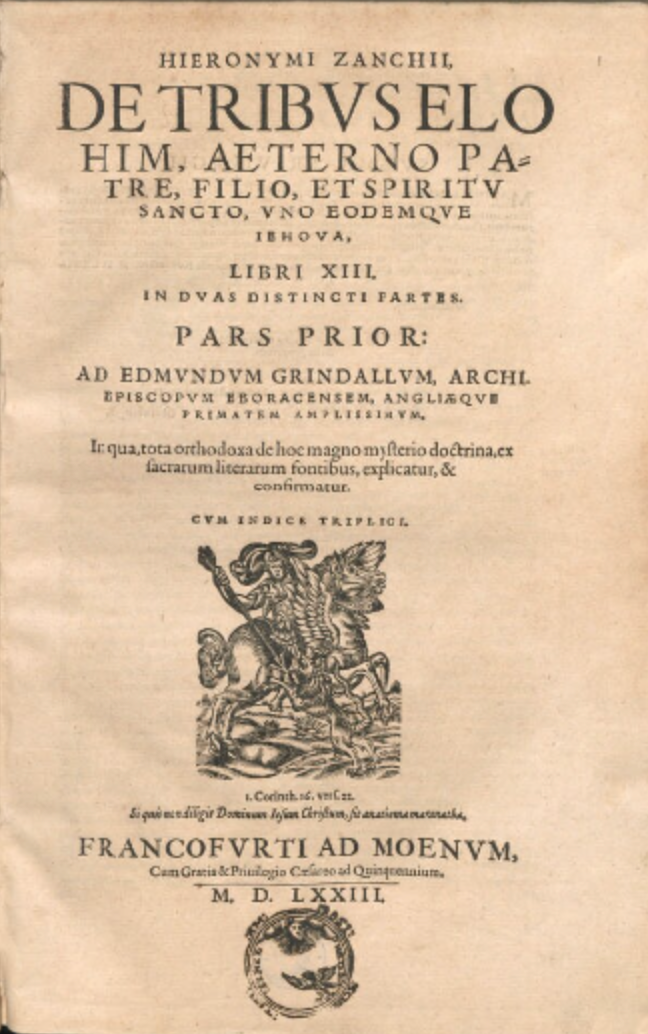
[6] That is, De tribus Elohim.
[7] ὑποστάσεις.
[8] Zanchi relies upon an uncommon textual variant here. He also cites Isa. 44:24 (along with Isa. 54:5, Ps. 149:2, Gen. 20:13, and others) to make the same point in De tribus Elohim, pt. 1, bk. 2, ch. 1, §4.
[9] ורוח אלוהים מרחפת.