
Now I am going to run through and briefly touch upon certain names whereby God actually describes what He Himself—Father, Son, and Holy Spirit—is like.
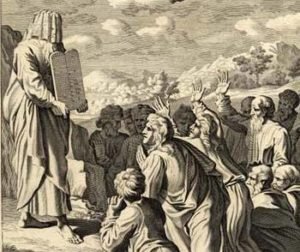 Moses had entreated the Lord to show His face to him, that is, to fully and completely reveal His glory and majesty to him. The Lord responded that He could not oblige him in this because it would be ruinous to Moses rather than beneficial. He says: For man will not see Me and live (Ex. 34 [that is, Ex. 33:20]). That is, No man can see My face and majesty, lest he immediately be overwhelmed by it and reduced to nothing. Accordingly, the Lord was willing to manifest Himself to Moses in another way: by way of His backside or from behind, that is, in part and to a certain extent, dimly, in such a way that Moses could receive that knowledge and light.
A parallel exists that is taken from men. For if we see someone 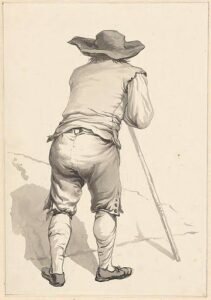 from behind, we only know them in part. Hence, the Lord promises knowledge of Himself with these words, but He promises an imperfect and partial knowledge. He confirms this same thing with a certain sign, saying: It will happen that when My glory passes by, I will put you in a cave of the rock, and I will cover you with My hand while I pass by [Ex. 34:22]. The meaning is: You will be in a cave, where there is a small and slanting [obliquum] hole through which you can look. You will look through that hole while I pass by with My glory in the likeness of the sun.
What is more, this sign means nothing other than that, in this mortal life, we cannot see God except in part and dimly, as the apostle says [1 Cor. 13:12]. The reason for this is: We cannot look at that light directly and freely. But He casts His light upon us indirectly, so that we might (as it were) see Him from behind and in part. He indicates the same thing with the verb passing by. For we only see things when they pass by us. We cannot keep our eyes fixed on them, so we are not actually able to know them completely, only incompletely and in part.
What, then, do all these things mean? Nothing other than that, while in this mortal life we cannot know God—not what He is like and even less who He is—by His face, that is, from the front and with a direct gaze. Rather, we can only see Him from behind (that is, His backside) by what He accomplishes, from the Word, from the sacraments, from signs, and, so, merely in part and dimly.
Consequently, this is how the Lord reveals Himself by word to Moses and to us, saying: Jehovah, Jehovah. First, He offered the name whereby He indicated His substance, and He even repeats it: Yah, Yah, Yah, Yah.[1] The repetition is only for emphasis, so that Moses would pay closer attention. Next, He adds other names or epithets whereby He describes what He is like. All of them, however, are reduced to three headings: power, goodness, and righteousness. He expresses His power with the single word El.[2] He expresses His goodness toward us with seven words that actually signify seven different things, yet all of them have to do with amplifying the divine goodness. Finally, He displays His righteousness with two phrases.
Everything else refers back to these three qualities (or rather, divine properties), as anyone gifted with even moderate judgement can see. He therefore indicated what He is like—abundantly and summarily—with these few words.
I. He declares His strength or courage by saying El.[3] This knowledge of God’s power is useful and necessary for us. I say, it is useful both in bearing adversities (for God is El,[4] strong and powerful, so He can deliver us from afflictions) and also for managing good fortune with fear (for God is El,[5] and, just as He gives us our good fortune, so He can also take it away, if we squander it). Finally, knowledge of God’s power is also useful for sustaining us in faith (for the God who promises is also powerful to make good on His promises, just as Romans 4 says He did for Abraham).