
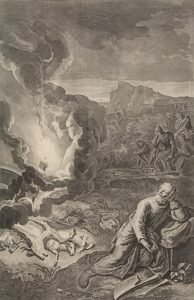
 I. That is why I combine the fifth interpretation with the third opinion, and I say that two of God’s essential attributes are indicated, neither of which can belong to any created thing: eternity and immutability.
Eternity is indicated when God says I will be. For what creature can truly and properly say I will be? And immutability is indicated when He says אהיה אשר [asher Ehyeh], as if to say: Not only will I be (namely, forever), but I will also always be as I will be. Thus, this suits the current context very well—delivering the people out of Egypt according to the promise made to Abraham four hundred years previously. Therefore, the meaning is: My name is ὁ αἰώνιος, καὶ ὁ ἄτρεπτος: He who is eternal and who is immutable. Moreover, these [essential attributes] signify God. For every creature is both temporal and mutable, so only God alone can truly say I will be, and likewise I will be who I will be.
The meaning, therefore, is: Go and say that He who is eternal and He  who is immutable sent me to you. Indeed, God confirms the promise by this double epithet, that in every respect He will be with Moses in delivering the people as He promised previously, so that He will free the people utterly, just as the sixth interpretation has taught. For since God is eternal and immutable (or: always the same), He cannot not free His people, because He had promised it to Abraham and had indicated that this is His will, which is what He also confirmed at the present time to Moses. Accordingly, He cannot alter His resolution. Therefore, the people must necessarily be delivered in accordance with the promise made to Abraham.
This seems to me to be the natural meaning, if we retain the future tense reading in accordance with the sound of the Hebrew words. Thus, the sense is, as I said: Go and say that He who is eternal and immutable and who, therefore, cannot not deliver you, His people, according to the promise made to Abraham—say that He has send me unto you for this purpose: in order to deliver you through me.
III. But Scripture often uses a future verb to indicate present tense—not in a simple sense but with the sort of present tense that indicates ongoing action.[1] And thus, the Septuagint renders it as Ἐγὼ εἰμὶ ὁ ὤν: I am the One who is, which name appears frequently in the New Testament. For this reason, we also must explain the name the One who is.[2]
Therefore, in the first place, this name clearly indicates a simple, perfect, and eternal essence. For He does not say I am of such and such a kind, or I am like this or like that but simply: the One who is.[3] Hence, this signifies a simple and absolute (and thus, perfect) essence. On the other hand, He who can say I am the One who is[4] predicates that He is the One from whom anything that exists and lives (to the extent that it exists and lives) can be predicated. For He who is the One who is[5] in a simple sense is actually also essence and life; He is intellect and wisdom; He is absolute power; He is (finally) whatever signifies a particular perfection.
Second, since He does not say I was or I will be but the One who is,[6] He demonstrates that He is eternal. For He who actually is the One who is[7] always was, is, and will be. Otherwise, the name the One who is[8] would not be His proper name, since it would not always be suitable for Him but only sometimes. But the One who is[9] is God’s proper name. Hence, it indicates God’s eternity.

Thus, even Plato grasped this name of God, albeit in the neuter gender (τὸ ὄν), because he saw that it expressly signified the eternal and most simple and perfect essence.[10] Among the works of Augustine, toward the end of the sixth tome, there is a treatise on God’s words to Moses: I am who I am.[11] His judgement is that this name is only appropriate for God on account of the fact that it indicates the utterly simple, perfect, and eternal essence.[12] It is a learned treatise.
 Rabbi Moses Egyptus [that is, Moses Maimonides] reads ὁ ὤν (I am who I am) in the same way and carefully explains why God did not simply say I am but rather added who I am. He is of the opinion that the first I am is the name (that is, אהיה; ὁ ὤν) while the other (namely, to be אשר אהיה) is the surname ([The Guide to the Perplexed,] bk. 1, ch. 62 [that is, ch. 63 in modern editions]).[13] So, the sense is: I am a thing-that-is, but I am not the sort of thing-that-is that merely subsists by means of something else. Rather, I am a thing-that-is that subsists on My own. And for that reason, I am My being and My essence, and My being does not differ from My essence because I am who I am.
 We saw above what the Damascene wrote about this name. [He said] that ὁ ὤν [the One who is] is God’s proper[14] name, and God called Himself this because the name contains in itself all and utterly perfect being.
 Thomas Aquinas proposes three reasons to demonstrate that this name is the most proper of all God’s names (Summa theologiae, I, q. 13, art. 11). First, because it does not indicate any form but simply being itself. I explain: When we say I am a man; that is a horse, we are indicating certain forms and natures, namely, human and equine. But if you say He is being, you will not be indicating a specific form, since everything that is is being. Rather, the word simply indicates being itself. Moreover, there is no created thing which is being in a simple sense. Rather, a creature is this or that being endowed with this or that form. Therefore, since God is called simply the One who is,[15] the fact that God is absolutely simple and perfect being itself is signified. And thus, this is God’s most proper name, for only God is being itself, and only God is His being and His essence.
The second reason is: Because this name is utterly universal, so to speak, embracing all being [entia] in itself and, as the Damascene says, because it indicates the sort of being which, like an infinite and boundless sea, comprehends all being in itself.[16] And so it is, for as all things are from God, so they are also in God and subsist in Him. Hence, in Acts [17:28] it says: In Him we live, move, and are. And thus, God Himself simply and universally is being, the One who is.[17]
Aquinas adds a third reason: Because this name indicates neither past nor future but present being: the One who is.[18] Indeed, it is proper to God that His being knows neither the past nor the future but only the present, for He is not liable to any change. Based on these three reasons, Aquinas concludes that this name—I am who I am or the One who is[19]—is God’s most proper name.
But on the basis of this threefold rationale, we gather a fourth, which pertains more directly to the passage in question in Exodus: Because this name also indicates God’s faithfulness to His promises. For if, because ὤν is in the present tense, it indicates a being who is not liable to any change but always is the same (and, so, is God), then it also follows that God is steadfast and unchangeable in His promises. This is why אהיה is quite correctly translated as ὤν in Exodus 3 in order to signify that He persists in every respect in His purpose and desire to deliver His people, just as He had also been when He made this promise to Abraham. And thus, the One who is is correctly called God’s proper name. And this suffices concerning this name.