
Five Books on the Nature of God,
or
On the Divine Attributes
or
On the Divine Attributes
By Girolamo Zanchi
Translated by Patrick J. O'Banion
Book 1, Chapter 13, Part 2
Volume 1 is available for order now
from Merchant Royal Press
Who fails to see that God clearly declares Himself to be Jehovah not only because He is self-subsisting from eternity but also because He works all things with supreme and irresistible omnipotence, and ... because He actually keeps His promises, causing them (as it were) to stand firm?
Girolamo Zanchi
The Etymology and Proper Meaning
of the Name יהוה
Third, with regard to the name’s etymology and proper meaning, in principle no controversy exists about its being derived from the verb הוה or היה, both of which mean to be. If you derive it from היה, with one of the Eytan letters[1]—namely, yod—added to the verb to indicate a third person singular future tense, then it is יהיה (whence: יהוה), with the second yod, namely the radical, in the converse. If, however, you derive it from הוה, no letter is changed but only vowel points. Even so, there are those who reject the idea that the first letter (yod) is an Eytan letter, constitutive of the future tense. Rather, they understand the yod to be a Hemantic letter,[2] which makes a noun substantive, just as is likewise the case with יעקב [Jacob] from עקב [to supplant] or יצחק [Isaac] from צחק [to laugh].
Yet, however it is derived, whether from היה or from הוה, the name יהוה is clearly from the verb that means to be. But I do not hold with those who want the name Jehovah to be derived in the first instance from what God told Moses—This is My name: אהיה אהיה אשר [Ehyeh asher Ehyeh; Ex. 3:14]—because the name Jehovah was revealed to the patriarchs long before that, from the foundation of the world, as I will soon show.
Certainly, that passage does demonstrate that the name יהוה is derived from the either the verb היה or הוה, for the One who had first said that His name is אהיה (Ehyeh [Ex. 3:14]), later said that His name forever is Jehovah [Ex. 3:15]. Hence, יהוה is from היה. But that it was first, at that moment, derived from the future-tense verb is false. Moreover, to come to the point, the proper meaning of the name יהוה is easily gathered on the basis of etymology. It means in the first place: He
who inherently always was, is, and always will be, or: the most perfect, simple, and eternal essence subsisting of Himself and by means of Himself. In the second place, it means: He is the Creator, Originator, and Preserver of all things which have ever been, are, or will be. And last, it means: He is utterly truthful and constant in His promises, ultimately fulfilling and granting, as it were, real existence to His promises. Moreover, none of these three is applicable to any creature but only to God, as I will soon show. Thus, the name Jehovah is God’s essential and proper name, which means that He is, without mediator, the eternal and most perfect Creator of all things, Gatherer of the church, and Savior God.
Now, I will demonstrate each one of these three meanings based on the radical of the name and confirm them by Scriptural testimony.
First, taken simply, the very root of the name—the word היה—demonstrates what we are saying. For to Him belong, in a simple way, apart from time and without beginning, the word being and the name essence. He is an utterly perfect, most simple, and eternal essence, subsisting of Himself and by means of Himself. Moreover, He alone is God, who alone and without qualification [simpliciter] is called Jehovah. This is why, in Exodus 3, He calls Himself He who is and will be without qualification, saying that this is His name: אהיה, I will be, which also incorporates the present tense, so that the Septuagint translated it: the One who is.[3] Hence, it means: He who most perfectly and simply is, subsisting of Himself and by means of Himself.
And if you carefully consider the name Jehovah, you will clearly see contained there the eternal and most perfect essence, and you will see that it signifies He who was, who is, and who always will be. Moreover, that is a title suitable to God alone, as is also apparent in Revelation 1[:4], where God is called who is, who was, and who is to come.[4] These three tenses are also indicated in the vocalized word יהוה.
First, remove the Eytan yod, constituting the future tense, and you will have only the radical היה (was). This corresponds to what is in Revelation 1:4: who was.[5] Second, remove the chametz from the word היה and change it to a cholem without any change in the letters. Instead of the past tense היה or הוה, you will have a Benoni present: הוה (being or existing), and this corresponds to who is.[6] Third, take the yod (י), which is set before this verb in the future tense to make יהוה. You will have the future tense (will be), to which corresponds the third title in Revelation [1:4]: and who will be[7] as well as the first-person verb in Exodus 3[:14]: אהיה (ehyeh; I will be).
Thus, properly speaking, the name Jehovah actually means to be eternal, most perfect, and most simple. Likewise, what the Hebrews say is pertinent: This name is composed of spiritual letters, because it actually signifies a spiritual essence.[8] This is the first meaning of the name יהוה.
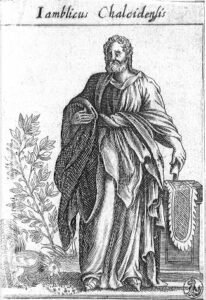 Some philosophers discerned the very same thing, especially those who read the books of Moses—or at least they heard them being explained—such as Plato and others. Plato called God τὸ ὄν, the One who is inherently and simply eternal. And in the Timaeus, Plato seems to reproach those who attribute either time future or past to the divine essence—neither of which is appropriate—instead of only the present. Iamblichus Platonicus[9] calls God the most senior, the most honored, and that which is by its own nature [On the Mysteries, bk. 1, §5].[10] When asked, What is the divine (or: God)? Thales of Miletus responded: That which has neither beginning nor end.[11] Indeed, among the Egyptians, it was written of God in a temple, as though He were speaking of Himself: I am all that has come into being, and that which is, and that which shall be.[12]
who inherently always was, is, and always will be, or: the most perfect, simple, and eternal essence subsisting of Himself and by means of Himself. In the second place, it means: He is the Creator, Originator, and Preserver of all things which have ever been, are, or will be. And last, it means: He is utterly truthful and constant in His promises, ultimately fulfilling and granting, as it were, real existence to His promises. Moreover, none of these three is applicable to any creature but only to God, as I will soon show. Thus, the name Jehovah is God’s essential and proper name, which means that He is, without mediator, the eternal and most perfect Creator of all things, Gatherer of the church, and Savior God.
Now, I will demonstrate each one of these three meanings based on the radical of the name and confirm them by Scriptural testimony.
First, taken simply, the very root of the name—the word היה—demonstrates what we are saying. For to Him belong, in a simple way, apart from time and without beginning, the word being and the name essence. He is an utterly perfect, most simple, and eternal essence, subsisting of Himself and by means of Himself. Moreover, He alone is God, who alone and without qualification [simpliciter] is called Jehovah. This is why, in Exodus 3, He calls Himself He who is and will be without qualification, saying that this is His name: אהיה, I will be, which also incorporates the present tense, so that the Septuagint translated it: the One who is.[3] Hence, it means: He who most perfectly and simply is, subsisting of Himself and by means of Himself.
And if you carefully consider the name Jehovah, you will clearly see contained there the eternal and most perfect essence, and you will see that it signifies He who was, who is, and who always will be. Moreover, that is a title suitable to God alone, as is also apparent in Revelation 1[:4], where God is called who is, who was, and who is to come.[4] These three tenses are also indicated in the vocalized word יהוה.
First, remove the Eytan yod, constituting the future tense, and you will have only the radical היה (was). This corresponds to what is in Revelation 1:4: who was.[5] Second, remove the chametz from the word היה and change it to a cholem without any change in the letters. Instead of the past tense היה or הוה, you will have a Benoni present: הוה (being or existing), and this corresponds to who is.[6] Third, take the yod (י), which is set before this verb in the future tense to make יהוה. You will have the future tense (will be), to which corresponds the third title in Revelation [1:4]: and who will be[7] as well as the first-person verb in Exodus 3[:14]: אהיה (ehyeh; I will be).
Thus, properly speaking, the name Jehovah actually means to be eternal, most perfect, and most simple. Likewise, what the Hebrews say is pertinent: This name is composed of spiritual letters, because it actually signifies a spiritual essence.[8] This is the first meaning of the name יהוה.
Some philosophers discerned the very same thing, especially those who read the books of Moses—or at least they heard them being explained—such as Plato and others. Plato called God τὸ ὄν, the One who is inherently and simply eternal. And in the Timaeus, Plato seems to reproach those who attribute either time future or past to the divine essence—neither of which is appropriate—instead of only the present. Iamblichus Platonicus[9] calls God the most senior, the most honored, and that which is by its own nature [On the Mysteries, bk. 1, §5].[10] When asked, What is the divine (or: God)? Thales of Miletus responded: That which has neither beginning nor end.[11] Indeed, among the Egyptians, it was written of God in a temple, as though He were speaking of Himself: I am all that has come into being, and that which is, and that which shall be.[12]
All these things confirm what I said with regard to the first meaning of the name Jehovah, namely, that it signifies the eternal, most perfect, most simple essence existing of itself and by means of itself.
Next, Jehovah signifies the sort of eternal essence which is also the first and principal cause of all other essences and of all that exists,[13] namely, the Source and Preserver of all things. He teaches this in Isaiah 44:24, where He shows Himself to be Jehovah because, unlike men, He created all things, even all the heavens and the dry land. He says: I am Jehovah, making all things, and rightly so. For, if Jehovah means the eternal and most perfect essence, existing by means of itself and from itself as we saw previously, then it also means that He is the sort of essence from which are all things that are and by means of which all things are ruled. Hereto pertains what the apostle said when he described Jehovah: from whom all things, through whom all things, in whom all things (Rom. 11:36). And what he says in Acts 17:28: He is the One in whom we live, move, and are.
Finally, it signifies the sort of eternal essence that created, preserves, and rules all things and that also, by fulfilling His promise in a specific way, causes them to be and really to subsist. Jehovah Himself teaches this in Exodus 6:3: I appeared to your fathers with the name Shaddai,[14] and I did not make Myself known to them with My name יהוה. Indeed, as will be explained more fully in short order, the meaning is that, besides declaring Himself to be Shaddai[15] (the almighty and sufficient One, the Granter of all blessings) by showing His power in the world’s creation, its destruction by water, and in many other ways, He also did so by bestowing many blessings and resources upon the patriarchs. But He had not yet actually declared Himself to be Jehovah, since He had not yet made good on the promise that He had made to Abraham and the other patriarchs long before: to set His people free from Egypt.
Now, with His promise fulfilled, He will take that name upon Himself. So, He openly taught that the name Jehovah means: He who is steadfast in all His promises and, as it were, causes all His promises to stand firm. Hence, after He has fulfilled the promise of freeing His people, as soon as He mentions their liberation, He calls Himself Jehovah in order to assert this. Thus: I am Jehovah Elohim, who led you out of the land of Egypt (Ex. 20:2).
In fact, in Isaiah 43, God clearly—even eloquently—puts forth all three of these meanings[16] at the same time. With regard to the first, He says: I am Jehovah, that you may know and understand that I am He (namely, existing by means of Myself and from Myself ). Before Me no God was formed, nor will there be after Me (v. 10). It as if He were to say: I alone am the eternal God, the One who is.[17] With regard to the second, He adds: I am Jehovah, and from the beginning I am He, and there is none who may pluck from My hand. I will work, and who is there who may divert it? (v. 13). Hence, it means that He is the first cause of all things and the first Doer and Creator. He adds the third meaning concerning His promises: Behold! I will do something new. Now it will blossom forth. Will you indeed not know this? (v. 19). Who fails to see that God clearly declares Himself to be Jehovah not only because He is self-subsisting from eternity but also because He works all things with supreme and irresistible omnipotence, and (lastly) because He actually keeps His promises, causing them (as it were) to stand firm?
Now we have grasped this name’s proper meaning based on its etymology.
[1] That is, the Hebrew letters איתן, one of which appears at the beginning of a Hebrew verb conjugated in the future tense.
[2] Hemantic words are those Hebrew radicals made substantives by the addition of one of the following letters: המאנתי.
[3] ὁ ὤν.
[4] ὁ ὤν, ὁ ὴν, & ὁ ἐρχόμενος.
[5] ὁ ὴν.
[6] ὁ ὤν.
[7] καὶ ὁ ἐρχόμενος.
[8] οὐσίαν.
[9] Iamblichus Platonicus (245–325), also known as Iamblichus Chalcidensis, was an influential Syrian Neoplatonist.
[10] οὐσίαν τὴν πρεσβυτάτην, καὶ τιμιωτάτταν, καὶ καθ αὐτὴν οὖσαν. Quoted from Iamblichus: De Mysteriis, trans. John Myles Dillon et al., Writings from the Greco-Roman World (Society of Biblical Literature, 2003), 21 (altered).
[11] τὸ μήτʼ ἀρχὴν ἔχον, μήτεʼ τέλος. This opinion of Thales is recounted in a number of sources, both Christian and pagan, among them Hippolytus, The Refutation of All Heresies, bk. 1, ch. 1 and Diogenes Laertius, Lives of Philosophers, bk. 1.
[12] Ἐγω εἰμὶ πᾶν τὸ γεγονὸς, καὶ ὃν, καὶ ἑσόμενον. This inscription is reported by Plutarch (Isis and Osiris, §9) to have been found in the temple at Sais.
[13] καὶ πάντων τῶν ὄντων. The source of this quotation is not clear. It may be a reference to 1 Tim. 2:2, but more likely Zanchi is drawing upon either Clement of Alexandria, The Stromata, bk. 6, ch. 16 or John of Damascus, On the Orthodox Faith, bk. 2, ch. 1 (§16).
[14] שדי.
[15] שדי.
[16] That is, that God is the almighty and sufficient One, the Granter of all blessings, and the Savior of His people.
[17] ὁ ὤν.