
When [God] is said to be “angry” with the wicked and pleased with the good, they are changed, not Him.
Augustine
Five Books on the Nature of God,
or
On the Divine Attributes
or
On the Divine Attributes
By Girolamo Zanchi
Translated by Patrick J. O'Banion
Book 1, Chapter 10, Quaestio 9, Part 1
Volume 1 is available for order now from Merchant Royal Press
The Final Quaestio
Since God is eternal and immutable and nothing new happens to Him, are any names suitable for Him in time in such a way that they would not be relevant to Him from eternity?
The Thesis
The names that indicate a relationship between God and created things, such as the names Creator, Lord, Savior, Redeemer, and so on, are temporally but not eternally predicated of God in such way that, nevertheless, nothing new befalls Him nor does any change occur in Him.
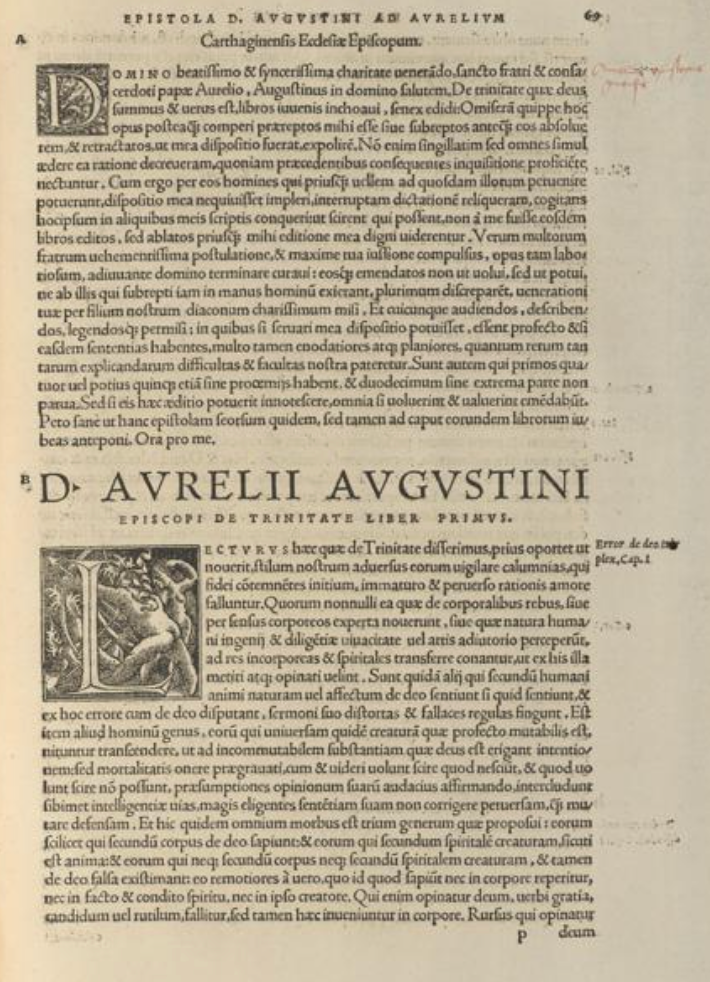
Augustine addresses this question in Trinity, and in summary he teaches that that which signifies a relation between God and creatures can be said of God in time, yet no change occurs in God but only in the creatures themselves (tome 3, bk. 5, ch. 16 [that is, ch. 4, §17]).[1]
Moreover, Augustine begins by proving the first proposition of our thesis, then the second, and then he illustrates it with examples. With regard to the first proposition, in sum, he writes the following: No one can be called a master who has not yet begun to have a slave, just as anyone called a slave has a master. But we, of whom He is Lord, were not slaves from eternity. Rather, we were made in time and became His servants. Therefore, He became our Lord in time. And yet, no change occurs in God on this account as Augustine explains with an altogether apt analogy. Go read Augustine himself.
Furthermore, with regard to the second proposition, he says the following:
A coin, when it is called a price is spoken of in a relative way, and yet it does not change when it begins to be a price or a pledge or anything like that. A coin, therefore, can be spoken of relatively so many times—whenever it begins or ceases to be called something—without any kind of change taking place in its nature or form as a coin. How much more easily should we understand that, while God’s immutable substance may be described relatively so as to speak of Him with reference to creation in such a way that He begins to be spoken about thus in time, nevertheless, nothing is understood to have happened to God’s own substance but rather to the creature unto whom it is spoken?[2]
Then, with the words of Scripture, Augustine immediately confirms and simultaneously explains what he had previously stated:
Lord, You have become our refuge [Ps. 90:1]. Therefore, God is called our refuge relationally, for that name is spoken with reference to us, and He becomes our refuge when we flee unto Him. So then, can it be that something happens in His nature that was not the case before we took refuge in Him? Therefore, some change happens in us. For we were worse before we took refuge in Him and, having gone to Him for refuge, we become better, but nothing happens in Him. Similarly, He also begins to be our Father when we are regenerated by His grace, because He gives us power to become the sons of God [John 1:12]. Therefore, our substance is changed into something better when we are made His sons and, at the same time, He begins to be our Father, but without any change to His substance. Therefore, that which God begins to be called in time that was not previously said about Him is obviously said in a relational sense. Yet it is not said relatively according to what is accidental in God, as if something happened to Him. Rather, it is clearly said accidentally of that with respect to which God begins to be called something in a relative sense.[3]
Augustine adds another example, saying:
And insofar as a just man begins to be a friend of God, he is changed, but far be it that God should love someone temporally, as if with a new love that was not previously in Him in whose presence past things do not pass away and future things have already happened. Accordingly, He loved all the saints before the foundation of the world, even as He predestined. But when they are converted and find Him, then He is said to begin to love them. It is said in that way so that it is said in a way which can be grasped by human feeling.[4]
He adds another example: And similarly, when He is said to be “angry” with the wicked and pleased with the good, they are changed, not Him. In the same way, light is harsh in weak eyes and easy to strong eyes because they change, not because the light does.[5] Thus far Augustine, in whose writings both parts of our thesis are clearly explained and amply confirmed.