
I am of the opinion that many of the things corporeally predicated of God in the Old Testament are not so much pre-dicated figuratively of the divine essence as properly with respect to the Son who would take on flesh and personally perform these corporeal works.
Girolamo Zanchi
Five Books on the Nature of God,
or
On the Divine Attributes
or
On the Divine Attributes
By Girolamo Zanchi
Translated by Patrick J. O'Banion
Book 1, Chapter 4, Part 3
Volume 1 is available for order now from Merchant Royal Press
(9.) Of all the names spoken affirmatively about God, some are spoken properly, and others are spoken improperly and figuratively.
Affirmative names properly spoken include the name Jehovah as well as others that signify His essence or essential attributes (as we will indeed demonstrate with each of the attributes) or the persons and personal properties. I add to these the names Creator, Redeemer, and others like them. For all these are predicated properly of God, without any trope or figure of speech.
On the other hand, names spoken improperly and figuratively signify the sort of things which, in their proper signification, are in some way inappropriate [competunt] for God. Such are names signifying corporeal things, words, and actions. For God is not corporeal, nor do corporeal things or actions pertain to [cadunt in] Him.
Accordingly, it is necessary for all of these to be understood figuratively as a kind of anthropopathism.[1] For spiritual things are signified by means of these corporeal things, and they display in a general way what God is like. So, when they attribute eyes to God, His omniscience is signified, because nothing escapes His notice. When hands and arms are attributed to Him, they signify His omnipotence, because He does all things and works powerfully in all things. And so on with the rest.
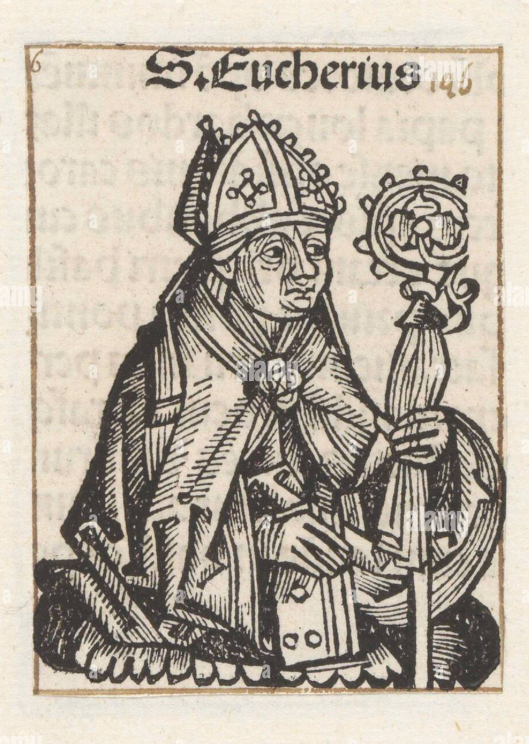
Master Eucherius, Bishop of Lyon wrote a little book about these things.[2] And among the works of Augustine, there is a small work in the fourth tome entitled On the Essence of Divinity.[3] On this topic, see also the Damascene, [On the Orthodox Faith,] bk. 1, ch. 14 [that is, ch. 11].[4] It was out of an ignorance of this distinction about the names of God and about this rule that the heresy of the Anthropomorphites was born, against which virtually all of the fathers wrote.
In fact, I will even observe something else about the names that signify human body parts and are attributed to God, even in the Old Testament. I am of the opinion that many of the things corporeally predicated of God in the Old Testament are not so much predicated figuratively of the divine essence as properly with respect to the Son who would take on flesh and personally perform these corporeal works.
Here is an example from Psalm 68:19 [that is, v. 18]. David assigns corporeal action to Jehovah God, saying: You ascended on high; You led captivity captive. In Ephesians 4:8, Christ is said to have done and fulfilled this when He ascended on high bodily. In Psalm 78:1 [that is, vv. 1–2], Asaph, speaking in the person of God, says: Attend to My law, My people; I will open My mouth in parables. With regard to the incorporeal Jehovah, the mouth that is given to Him is understood by means of anthropopathy.[5] But with respect to that same Jehovah being truly manifest in the flesh, it is understood truly and properly. That is why, when Matthew recounted what Jesus had taught through parables, he added the following words to show who that Jesus was, namely, He who had spoken previously in the person of Asaph: Jesus spoke all these things to the crowds through parables, and He said nothing apart from parables, in order that what was said through the prophet might be fulfilled, saying: “I will open My mouth in parables; I will utter what has been hidden from the foundation of the world” (Matt. 13:34[–35]).
And so, the same thing should also be said of many other scriptural passages where human body parts are attributed to God. Indeed, they should be understood figuratively with respect to the incorporeal God, but, because they were spoken prophetically with respect to that same God being manifest in the flesh (and of Him having been manifest), they should also be interpreted properly with regard to Christ.
(10.) Of those names which are spoken properly of God, some are spoken abstractly and others concretely. Abstractly, as when He is called life, light, salvation, deity, and love. And thus, Christ is called our wisdom and righteousness. Concretely, as when God is called the living One, Savior, the just One, and the Justifier.
Here is the rationale for this distinction, and it should be carefully noted. Names in the abstract signify two things. First, they actually signify the simplicity and perfection of the divine nature. In fact, abstract ideas [formae] are utterly simple and perfect. For goodness and light and whiteness and similar things lack all compositeness. This is why they are understood to be most simple ideas [formae], despite the fact that separate things are not really offered.[6] Nor is anything contrary to them intermixed in them, which is why they are utterly perfect. Accordingly, for this same reason, God also willed to be named by abstract names, and we understand Christ to be our (most perfect) righteousness.
The second thing that is indicated by abstract names is that God is the efficient cause of all life, wisdom, and goodness in other things. For all things live by some participation in the life that is in God, and so on for the other abstract names. However, God also willed to be named with concrete names (such as, the wise God, the true God, the living God) so that He might show that He is a thing [rem] truly subsisting (ὑφισταμένην).[7]
It seems to me that these ten distinctions comprehend every type of divine name. If someone has something more, it can always be added later. To have pointed the way seems to me sufficient.
[1] ἀνθρωποπάθειαν.
[2] Presumably, this is a reference to Eucherius’s fifth-century work Formulas of Spiritual Intelligence.
[3] Earlier in the sixteenth century, Erasmus had identified this work as a “mixed collection of various texts, partly by Jerome and partly by Augustine.” Arnaud S. Q. Visser, Reading Augustine in the Reformation: The Flexibility of Intellectual Authority in Europe, 1500–1620, Oxford Studies in Historical Theology (Oxford University Press, 2011), 90–91. For the text, see PL, 42:1199–1206.
[4] John of Damascus, On the Orthodox Faith, 85–87.
[5] ἀνθρωποπάθείαν.
[6] quanquam reipsa separatae non dentur. The force of this final clause is unclear but may indicate that multiple abstract formae predicated of God (such as goodness and light) are not given in order to indicate separate things in God but rather to emphasize divine simplicity.
[7] A res subsistens (a “thing subsisting” or “subsistens”) is Zanchi’s Latin translation of the Greek term ὑφιστάμενον, which he distinguishes (albeit not as clearly as one might wish) from the related term ὑπόστασις (“hypostasis”). The distinction is related to a subsistens’s concreteness and a hypostasis’s abstractness, as was suggested (with slightly more clarity) by Bernardus de Moor in Compendium theologiae christianae didactico-elencticum (Leiden, 1761), 1:700 (ch. 5, §II).