
No name can be found that can perfectly explain to us what the divine nature is or what it is like.
Girolamo Zanchi
Five Books on the Nature of God,
or
On the Divine Attributes
or
On the Divine Attributes
By Girolamo Zanchi
Translated by Patrick J. O'Banion
Book 1, Chapter 7, Quaestio 2, Part 1
Volume 1 is available for order now from Merchant Royal Press
Chapter Seven
Quaestio 2
As for the second quaestio—whether any name is predicated of God substantially (or essentially[1]), such that we can know God’s essence by that name—based on what has been said, the response should be easily discerned. Hence, let the thesis be: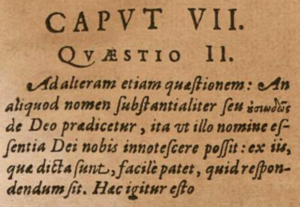
The Thesis
The divine essence cannot be expressed [exprimere] by any name, not even by an infinite number of names, so as actually to make who God is and what He is like in Himself comprehensible by any created intellect. Nevertheless, the many names in the Scriptures are of such a number and kind that they sufficiently indicate [indicare] to us the divine essence to the extent that is useful and necessary for us to know for our salvation.
This does not require a long, drawn-out confirmation, but some explanation is rather necessary. So, to begin, we must note what I said in the first part [of the thesis]: A created intellect cannot comprehend what the divine essence is or even what it is like in itself. This is not controversial. Hence, this very clearly follows as well: No name can be found that can perfectly explain to us what the divine nature is or what it is like.
The Damascene speaks to this point: The divine, being incomprehensible, is also necessarily nameless. Therefore, since we do not know its essence, we should not seek out its name, for names express actual things. ([On the Orthodox Faith,] bk. 1, ch. 12b).[2] A little earlier, I stated what Rabbi Moses [Maimonides] wrote about the name יהוה. But even if that name perfectly signified God’s essence[3] per se, it would not express it to us, since we are unable to perceive this name’s full force.
Next, note as well what is stated in the second part [of the thesis]: The names are, nevertheless, that whereby the divine essence is sufficiently indicated to us. This is what we said in Chapter 3, that among the divine names are those that signify the subject (that is, God Himself), such as Jehovah, Yah,[4] God, and other names of this sort. For although they by no means properly signify what He is, nevertheless, they do indicate who He is, and they reveal His nature.
But other names that are predicated of the subject—such as righteous, good, and the rest—signify God’s attributes, for they declare what the divine essence is like. Hence, all of the names, both those that indicate the subject as well as those that are predicated of the subject, were instituted to reveal the divine essence to us to the extent that doing so is worthwhile. And this is what I said in the thesis: The names are of such a number and kind as to sufficiently indicate to us the divine essence.
Lastly, we must remember certain things that were said about the divine names in general in Chapter 3, namely, that some names are spoken negatively of God and some are spoken affirmatively. Likewise, of those that are spoken affirmatively, some are predicated of God absolutely and other with relation to created things.
Accordingly, as far as pertains to those names which are spoken apophatically[5] of God, it is plain that they signify neither what the divine essence is nor what it is like but rather teach what the divine essence is not and what it is not like. For names such as invisible, immortal,[6] and others of this kind remove something from God and do not (properly speaking) attribute anything to Him, except that God is indirectly and by consequence signified to be something more excellent than any visible or corruptible thing.
The names that are stated relationally should be understand in the same way. For they signify the relation of God to creatures or of creatures to God rather than God’s essence. So, neither those names that are by way of negation nor those that are by way of relation can in any way be said to be predicated of God essentially.[7]
That being the case, which names are predicated essentially?[8] Those that are spoken of God affirmatively and absolutely. For instance, those that indicate the subject, such as Yah,[9] Jehovah, God,[10] and those names that express God’s essential properties, like righteous and good.
[1] οὐσιωδῶς.
[2] τὸ θεῖον ἀκατάληπτον, πάντως καὶ ἀνώνυμον ἔσται. Ἀγνοοὗντες οὖν τὴν οὐσίαν αὐτοῦ: τῆς οὐσίας αὐτοῦ μὴ ἐκζητήσορὲν ὄνομα. Δηλωτικὰ γὰρ τῶν πραγμάτων ἐστὶ τὰ ὀνόματα. Quoted from John of Damascus, On the Orthodox Faith, 88. Note that I have altered Russel’s translation so that δηλωτικὰ is translated with “express” rather than “indicative of.” “Express” (exprimere) is Zanchi’s rendering of δηλωτικὰ, which he contrasts with indicare in order to emphasize his fundamental agreement with the Damascene. See Wang, “Girolamo Zanchi and Divine Names” (2026), 188.
[3] οὑσίαν.
[4] יה.
[5] ἀποφατικῶς.
[6] ἄόρατος, ἄφθαρτος.
[6] οὑσιωδῶς.
[8] οὐσιωδῶς.
[9] יה.
[10] θεὸς.